
Balance sheet formats with worked examples: the Schedule III vertical format for companies, the horizontal T-form for firms, and a free Excel balance sheet template with a check that both sides agree.
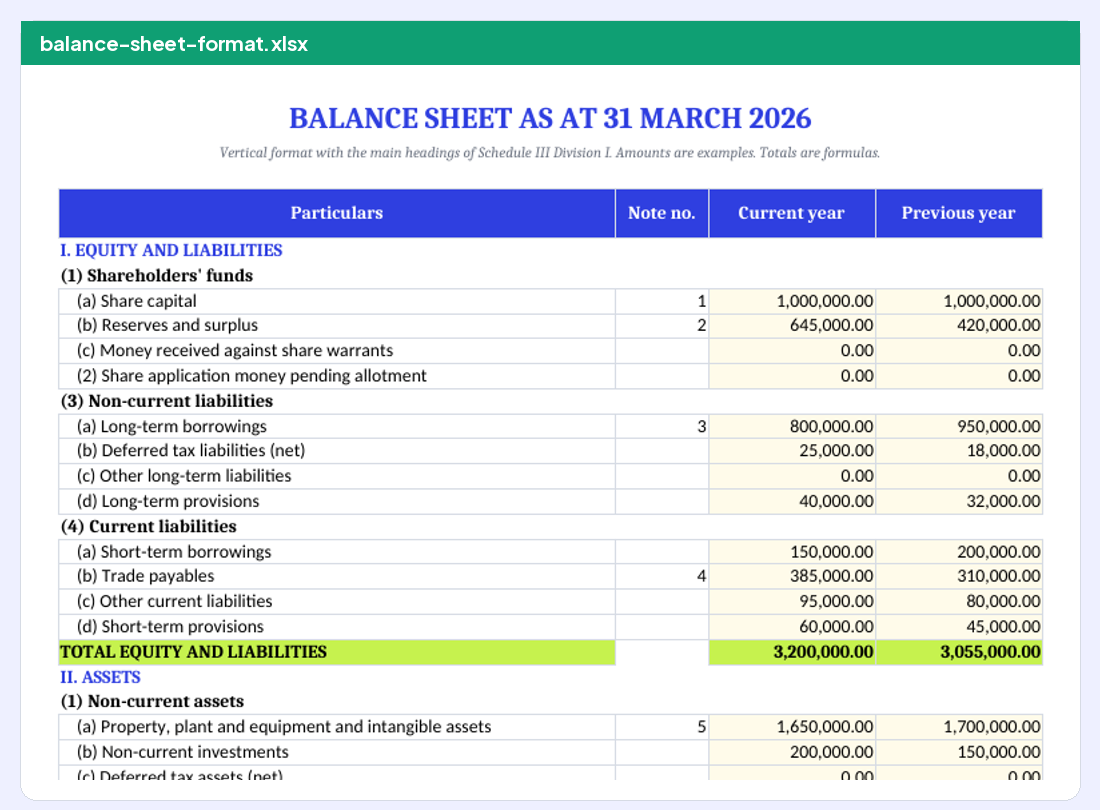
Balance sheet format as per Schedule III (vertical)
Companies in India prepare the balance sheet in the vertical form set out in Schedule III of the Companies Act, 2013 (Division I for companies following the older accounting standards). The main headings are below with a worked example of a small private company.
| Particulars | Note | Current year | Previous year |
|---|---|---|---|
| I. EQUITY AND LIABILITIES | |||
| (1) Shareholders’ funds | |||
| (a) Share capital | 1 | 10,00,000.00 | 10,00,000.00 |
| (b) Reserves and surplus | 2 | 6,45,000.00 | 4,20,000.00 |
| (2) Non-current liabilities | |||
| (a) Long-term borrowings | 3 | 8,00,000.00 | 9,50,000.00 |
| (b) Deferred tax liabilities (net) | 25,000.00 | 18,000.00 | |
| (c) Long-term provisions | 40,000.00 | 32,000.00 | |
| (3) Current liabilities | |||
| (a) Short-term borrowings | 1,50,000.00 | 2,00,000.00 | |
| (b) Trade payables | 4 | 3,85,000.00 | 3,10,000.00 |
| (c) Other current liabilities | 95,000.00 | 80,000.00 | |
| (d) Short-term provisions | 60,000.00 | 45,000.00 | |
| Total | 32,00,000.00 | 30,55,000.00 | |
| II. ASSETS | |||
| (1) Non-current assets | |||
| (a) Property, plant and equipment and intangible assets | 5 | 16,50,000.00 | 17,00,000.00 |
| (b) Non-current investments | 2,00,000.00 | 1,50,000.00 | |
| (c) Long-term loans and advances | 50,000.00 | 50,000.00 | |
| (2) Current assets | |||
| (a) Inventories | 6 | 5,20,000.00 | 4,40,000.00 |
| (b) Trade receivables | 7 | 4,65,000.00 | 3,90,000.00 |
| (c) Cash and cash equivalents | 8 | 2,30,000.00 | 2,55,000.00 |
| (d) Short-term loans and advances | 60,000.00 | 50,000.00 | |
| (e) Other current assets | 25,000.00 | 20,000.00 | |
| Total | 32,00,000.00 | 30,55,000.00 |
Horizontal (T-form) balance sheet for firms
Sole proprietors and partnership firms often use the older horizontal format: liabilities on the left, assets on the right.
| Liabilities | Amount | Assets | Amount |
|---|---|---|---|
| Capital (opening) | 5,92,000.00 | Machinery | 3,10,000.00 |
| Add: Net profit | 1,22,000.00 | Furniture | 85,000.00 |
| Less: Drawings | (48,000.00) | Closing stock | 1,45,000.00 |
| Bank loan | 1,50,000.00 | Debtors | 1,65,000.00 |
| Creditors | 1,18,000.00 | Cash at bank | 2,11,000.00 |
| Cash in hand | 18,000.00 | ||
| Total | 9,34,000.00 | Total | 9,34,000.00 |
This continues the trial balance and trading account examples on this site: net profit 1,22,000 is added to capital and drawings are deducted. Machinery is shown after the depreciation already charged in the books. Both sides must agree; the Excel template has a check cell that shows any difference.
Balance sheet format in Excel
The Excel version totals each side by formula and shows the difference, which should be zero. Change the year in the title and enter your figures in the yellow cells.
How to prepare a balance sheet
- Start from the trial balance. After all adjustments.
- Classify each balance. Equity, non-current or current liability; non-current or current asset. Current usually means due within 12 months.
- Bring in profit. Profit for the year goes to reserves and surplus (or capital for firms).
- Add notes. Schedule III requires notes for many items, such as share capital and trade payables ageing.
- Compare with last year. Show previous year figures side by side.
Notes to accounts: what Schedule III expects
Schedule III asks companies to give notes for many balance sheet items. Common ones are share capital (authorised, issued, subscribed), reserves and surplus (movement in the year), borrowings (secured or unsecured, terms), trade payables and receivables (ageing), property, plant and equipment (gross block, depreciation, net block), and inventories (by type). Our worked example numbers the notes 1 to 8 so you can see where they would go.
Balance sheet for a sole proprietor
| Liabilities | Amount | Assets | Amount |
|---|---|---|---|
| Capital | 5,00,000 | Shop furniture | 1,20,000 |
| Add: profit | 1,80,000 | Stock | 2,90,000 |
| Less: drawings | (60,000) | Debtors | 75,000 |
| Creditors | 1,10,000 | Cash and bank | 2,35,000 |
| Total | 7,30,000 | Total | 7,20,000 |
Spot the error: the sides differ by 10,000. In practice this is often an unrecorded liability such as an outstanding bill. The Excel template check cell would show the 10,000 difference immediately.
Ratios you can read off a balance sheet
| Ratio | Formula | From the example |
|---|---|---|
| Current ratio | Current assets / current liabilities | 13,00,000 / 6,90,000 = 1.88 |
| Debt to equity | Long-term borrowings / shareholders funds | 8,00,000 / 16,45,000 = 0.49 |
| Working capital | Current assets minus current liabilities | 6,10,000 |
Downloadable Excel
Frequently asked questions
What is the vertical balance sheet format?
Liabilities and equity first, then assets, one below the other, as in Schedule III. It is required for companies.
Do partnership firms have to follow Schedule III?
Schedule III applies to companies. Firms often use a horizontal format, though many now use a vertical layout too.
Where does profit go in the balance sheet?
Into reserves and surplus for a company, or added to the capital account for a proprietor or partners.
What is the balance sheet format for class 12?
Class 12 accountancy follows the Schedule III vertical format for company accounts. The headings above match it; follow your textbook for the exact sub-heads your board uses.
Checked and updated 14 Oct 2026. Independent template site; not tax or legal advice.